







Reconstructed Little Crater Lake Trail Improves Access to Popular Mt. Hood National Forest Destination
Clackamas County Office of Tourism-funded project replaces 1,500 feet of boardwalk and trail structures, adds ADA-accessible improvements and interpretive signage.
Article At A Glance
- A $146,089 grant from the Clackamas County Office of Tourism helped fund the reconstruction of 1,500 feet of boardwalk, trail puncheon and pavement, improving access to Little Crater Lake for visitors of all abilities.
- The ⅓-mile trail features two new benches and will include new interpretive signage.
- AntFarm Youth Services, volunteers and local partners completed the project, providing hands-on trail-building experience for youth crews while preserving this popular Mt. Hood destination for future generations.
AntFarm Youth Services, working with volunteers, has completed the reconstruction of the Little Crater Lake Trail, a project funded primarily by a $146,089 grant from the Clackamas County Office of Tourism (d.b.a. Oregon’s Mt. Hood Territory) through its 2026 Strategic Investment Program. The project replaced 1,500 feet of boardwalk, trail puncheon and pavement while also adding ADA-accessible improvements between the trailhead and Little Crater Lake. The project also installed two new benches and temporary interpretive signage describing the lake’s geologic formation, flora, fauna and traditional hunting and food gathering, with permanent signs expected to be installed in spring of 2027.
Located in the Zigzag Ranger District of the Mt. Hood National Forest, the ⅓-mile trail has long been a popular stop for Mt. Hood tourists and campers in the Timothy Lake area. The trail begins at the campground’s day use parking area and carves through Little Crater Meadow to Little Crater Lake, where a viewing platform overlooks the scenic, multi-hued spring-fed lake, before continuing on to the Pacific Crest National Scenic Trail. Originally built in 1967 by the Timber Lake Civilian Conservation Center, the trail was rebuilt in 1993 by the Mt. Hood Snowmobile Club to be ADA accessible to the lake viewing platform. The trail’s boardwalk and pavement had deteriorated over time, creating barriers for wheelchair and stroller use while prompting safety concerns along the segment leading to the Pacific Crest Trail (PCT).
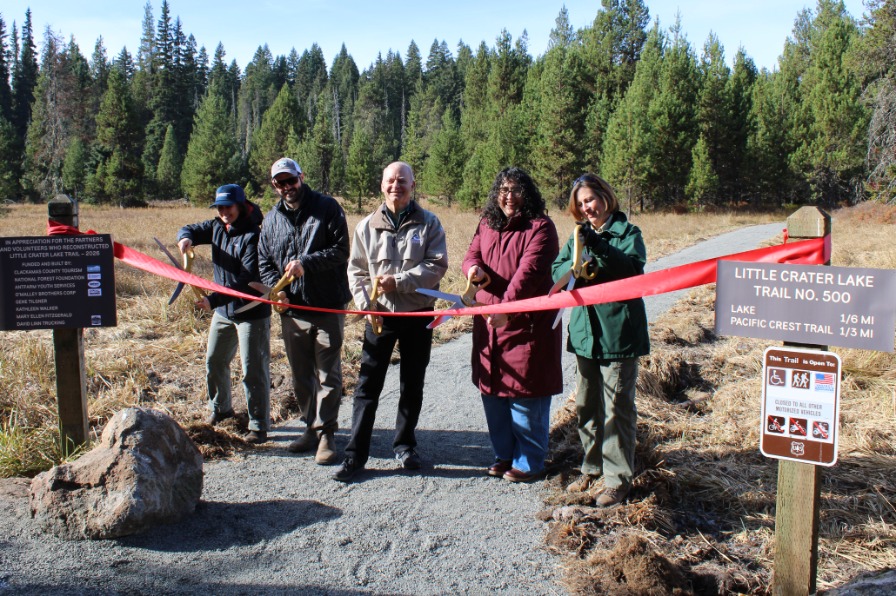
The ribbon cutting celebrating the official opening of the reconstructed Little Crater Lake Trail.
“Little Crater Lake has long been one of the most beloved destinations on Mt. Hood, and this project ensures it’s a place that every visitor can experience safely, regardless of ability,” said Lizzie Keenan, Executive Director of the Clackamas County Office of Tourism. “Projects funded through our Strategic Investment Grant Program reflect our commitment to making Clackamas County’s natural treasures accessible to all.”
Kathleen Walker, a retired Mt. Hood National Forest recreation manager worked with Neal Hatley at AntFarm Youth Services, a nonprofit organization based in Sandy, to obtain a grant, hire a trail crew and purchase materials. Neal hired longtime local trail builder Gene Tilgner to oversee the trail crew and operate heavy equipment. Kathleen designed the trail and sourced trail materials and worked with the trail crew building structures all summer. Access for All LLC helped provide input for barrier free design and the use of braille on interpretive signs.
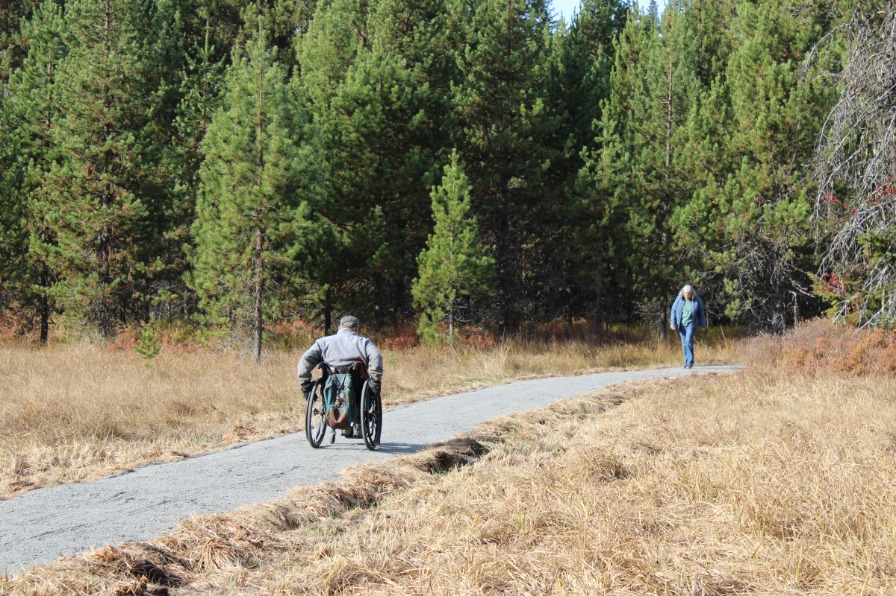
The reconstructed trail provides visitors of varying abilities a way to enjoy Little Crater Lake.
The AntFarm trail crew gained hands-on training in trail construction and conservation work through the project. The organization has partnered with Mt. Hood National Forest for more than a decade on trail improvements, campground rehabilitation and wildfire resilience work. “The Little Crater Lake Trail project gave our youth crews, volunteers and partners the chance to build something that will serve this community for decades,” said Neal Hatley, Deputy Director and Director of Workforce Development at AntFarm Youth Services. “Little Crater Lake has always been a special place within the region, and it’s rewarding to know that visitors of all abilities can now experience it the way it was meant to be enjoyed.”
Kathleen Walker, who also volunteers as Mayor of Sandy, was thrilled to see the project completed. “I spent years with the Forest Service watching this trail decline while knowing how much it means to the people who hike it and the families who visit the PCT and nearby Timothy Lake,” said Kathleen. “As Mayor, I also know that this destination reflects our entire region, since so many visitors pass through Sandy on their way to the forest. Making sure that experience reflects the best of what this area has to offer matters to me both personally and professionally.”
A ribbon-cutting ceremony and tour of the reconstructed Little Crater Lake Trail took place October 24, 2026, with project partners and community members in attendance.